Grab Touting Masa’s Backing Amps Up Southeast Asia Taxi Wars – Bloomberg

Grab Touting Masa’s Backing Amps Up Southeast Asia Taxi Wars – Bloomberg

I really like Tim for bucking the trend of most reporters and questioning all of this. I met Tim once in Singapore and we shared a meal and chatted. Really enjoyed it and I love that he is accessible and talks via Twitter.

https://twitter.com/dreampipe/status/1115410155468804096

He is willing to kind of say what most won’t:

What Grab failed to do, however, is show how having large tanks of kerosene to burn begets a sustainable business. That makes this bluster look a lot like Asia’s bike-rental wars, and we all know that didn’t turn out well. We shouldn’t be surprised that it’s Masa once again feeding the frenzy given his reputation as a big-stack bully.

No one knows where all of this will land. If the race is about raising piles of cash then I guess Grab is winning.

Obviously I like talking about this subject :: https://seedvc.blog/2019/03/22/my-take-grab-vs-go-jek-inside-asias-battle-of-the-super-apps-fortune/

However I am not sure that means they ultimately win – my issue is that both Grab and Go-Jek seem to think ridesharing forms the basis of a super-app. I am not sure I agree:

https://twitter.com/dreampipe/status/1115410823256522752


Scaling A Company While Controlling Costs – AVC

Scaling A Company While Controlling Costs – AVC

Interesting that Fred is suggesting companies reduce engineering costs by outsourcing to China.

I think this works for Zoom cause the CEO came from China and knows how to do it. My guess is most companies find the appeal attractive but will not have much success. You would need a solid executive lead in the company who can manage China and fold the results into the overall framework. I think few will be able to pull this off unless they have a Chinese exec on their team.

However I don’t think China is the only option but what is increasingly happening is the competition for these bodies is growing both from local companies and from regional startups. You see this very clearly in Indonesia with even the large players like GoJek having to do engineering abroad to compete.

As the entire startup ecosystem grows around Asia the local companies will probably be able to hire and manage better but I think the culture of working for an overseas company could also be attractive.

As tech goes global this pull for talent is only gonna increase and I am not sure the USA startup ecosystem will have the leg up for much longer. Since the rise of Asia is unstoppable at this point:

(My take) Can Blockchain Boost E-Commerce? A Singapore Company Says It Can – Bloomberg

First off I didn’t know they were #1 in Singapore – congrats.

I didn’t know about this https://www.quube.xyz/ , till I heard them shilling for coins on the radio.

It’s interesting but not sure it will work. We will have to wait and see.

Then this article comes out.

Can Blockchain Boost E-Commerce? A Singapore Company Says It Can – Bloomberg

What I don’t get is this:

Ku says blockchain makes it cheaper to run an online marketplace which lets him remove the fees he currently charges merchants to sell products on the site. That, he says, should attract even more sellers. Ku is also creating a payment system based on the technology that will help attract new shoppers in a region where cash still predominates. So far, the response has been positive: Three months in, he says, more than 5,000 merchants have registered 2.3 million or so products on QuuBe. 

Of course CEO’s will say anything but where is the concrete example of how blockchain will make anything he is talking about cheaper?

I don’t get it.

Why doesn’t the reporter clarify or ask for examples?

Maybe it relates to this:

The technology automates certain e-commerce transactions and processes that typically require humans. That’s why Ku can eliminate merchant fees and make it easier for anyone to set up an online shop. Blockchain also enhances trust among participants because they can more easily trace transactions from start to finish. 

In theory he is saying that blockchain will mean less bodies. That saves money if true but I don’t see how it works in practice to be honest.

Then this:

Meanwhile, the ledger offers an alternative, more secure payment method in a region where many shoppers lack access to financial services. Buyers and sellers use tokens called Q*coins, which are stored in a digital wallet in the QuuBe app. Q*coins are pegged to the U.S. dollar and fully convertible with no extra fees. As more of the tokens circulate, Ku says their value will appreciate—giving merchants another way to profit.

I always find it funny when people say crypto will help the unbanked. Really? How do the unbanked buy their crypto?

The main heading on their site is using your UOB card to buy tokens. Not sure that a UOB cardholder is an example of the unbanked.

I guess they can offer the ability for you to walk into 7/11 and buy coins but I wonder with it pegged to the USD what currency exchange bath you are taking.

Then it ends with:

But Ku is convinced blockchain will give him the necessary edge to compete and avoid getting into a cash-burning war of attrition. “I want to show that we can prevail by using technologies,” he says, “not by throwing money around.”

Still want to know what edge it gives him and how it saves him money. The article never really answers that.

Good times and I will admit to cheering him one since we need the competition.
Teflon Thailand

Linked to this yesterday :: https://seedvc.blog/2019/04/01/thai-election-gives-businesses-incentive-to-invest-abroad-bloomberg/

This is another good one :: https://asia.nikkei.com/Opinion/Teflon-Thailand-feels-the-heat

As stated yesterday – Thailand is underperforming and it could soon affect all aspects of Thailand.

This is the most alarming stuff:

Domestic strains abound, too. Household debt is, officially, an alarming 78% of gross domestic product. Officially, because this figure only reflects money owed to financial institutions. It does not account for a sprawling “gray economy” awash in curb-side lending that often comes with extortionate interest rates. Indonesia’s ratio, by comparison, is about 17%. In South Korea, a byword for household debt, it is 100%, but Korea is a much richer and more developed country.

As of August, roughly a quarter of households had trouble making repayments on car loans, credit-card debt and in other areas. This ranks among the most obvious barriers to Thailand raising GDP growth rates to the 5%-6% needed to reach middle-income status. Domestic consumption drives more than 50% of GDP. The more debt households take on, the greater the drag on growth.

Another problem the junta has not addressed: a demographic clock that is speeding up. Last month, the Bank of Thailand warned its “aging society” could be one of the first developing nations with an over-65 population of 14% or more by 2022.

As long as I have been in Asia Thailand has had and largely acted like Teflon.

It may not last folks.

Thai Election Gives Businesses Incentive to Invest Abroad – Bloomberg

I wonder if these issues are also now showing up in the startups stats. I see less and less interesting stuff from Thailand and the overall stats for new companies is down. Of course startups play out over a longer period in some sense but the same issues that are forcing Thai corporations overseas have to somehow affect entrepreneurs and their desire to incorporate in Thailand.

Thai Election Gives Businesses Incentive to Invest Abroad – Bloomberg

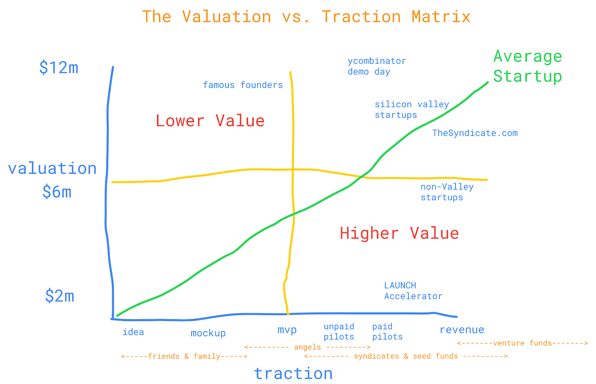
The Valuation vs. Traction Matrix – Jason Calacanis

Pasted image 0

Image from here :: The Valuation vs. Traction Matrix – Jason Calacanis

Great post. Will try to dive into it more later.

This is good though:

Startup valuations are not science, but they’re not magic either. It’s a bit of alchemy, combined with bizarre marketplace dynamics like famous founders getting 3x the price for half the traction, or Y Combinator hosting a gigantic demo day in order to create FOMO with novice investors who are explicitly told not to think things through and just cut a big check (literally, that’s their bad advice to investors).