Functionality Vs Content – AVC

Functionality Vs Content – AVC

The crux of this post is this part right here:

And most importantly, it is the frustrations of the prior model, as I mentioned above, that creates the opening for the new model.

So if you are working on a new model, for anything (it could be crypto, health care, education, finance, etc, etc), you should look very closely at what are the most annoying and frustrating aspects of the current model and focus on leading with features that remove them.


Mostly very real but sometimes I see people working on something because they discovered an annoyance but the market isn’t big enough, or there is not a willingness to pay. I want to caveat that part – the annoying better cross with some revenue potential. That being said I agree that there are things to fix in the world that people will pay for.

On to the streaming part, I admit that the announcement of a service I am even closely tempted to pay for without batting an eye is a Disney streaming service. I have kids, so it is a no brainer. All the back catalog Disney content is the best, and if you add in Star Wars, Marvel and anything else they have that is safe family content then for sure this is a must-have.

I defer on the tech and user experience till we can use it, but I doubt it functions as well as Netflix. I still find HBO lame as an app, and in Singapore, with the excellent internet it still sucks where Netflix is a flawless experience day in and day out. I mention HBO since it is built on Bamtech which is the company Disney mostly owns that started as MLB Tech. I want to guess that Warner sucks in building stuff so hopefully, Disney can do a better job, but all of them have a long ways to go tech wise to catch up to Netflix.

The other piece of this to watch is how this plays out globally, Netflix lite up the whole globe and that means you can get it practically anywhere and I am hoping Disney does the same. I wonder where these leaves the HOOQs, iFlixs, and Hotstars of the world over time. I think it comes down to Netflix, Prime Video and Disney forming the global lion’s share but will be interesting to watch how India fairs. China is China and all walled off so hard to say, but I bet Disney goes hard on it.
 

Montage Sequence #2 – bubbles, loonshots and the OA

Some great stuff in this issue.

This I think about a lot especially in the context of SEAsia:

4/ Finally, I was struck by how all the companies mentioned in the “bubble” pieces – often in reaction to the sticker shock of what seemed like a large valuation back then – went on to bigger and bigger valuations as time went on, often many times over. Which leads me to wonder:
a) why did so many commentators miss the growth that was going to happen to these companies?
b) is the same mistake being made now in the narrative around valuations?

Now I want this book :: Loonshots.

I am still struggling to like OA. 😉

Montage Sequence #2 – bubbles, loonshots and the OA

Grab Touting Masa’s Backing Amps Up Southeast Asia Taxi Wars – Bloomberg

Grab Touting Masa’s Backing Amps Up Southeast Asia Taxi Wars – Bloomberg

I really like Tim for bucking the trend of most reporters and questioning all of this. I met Tim once in Singapore and we shared a meal and chatted. Really enjoyed it and I love that he is accessible and talks via Twitter.

https://twitter.com/dreampipe/status/1115410155468804096

He is willing to kind of say what most won’t:

What Grab failed to do, however, is show how having large tanks of kerosene to burn begets a sustainable business. That makes this bluster look a lot like Asia’s bike-rental wars, and we all know that didn’t turn out well. We shouldn’t be surprised that it’s Masa once again feeding the frenzy given his reputation as a big-stack bully.

No one knows where all of this will land. If the race is about raising piles of cash then I guess Grab is winning.

Obviously I like talking about this subject :: https://seedvc.blog/2019/03/22/my-take-grab-vs-go-jek-inside-asias-battle-of-the-super-apps-fortune/

However I am not sure that means they ultimately win – my issue is that both Grab and Go-Jek seem to think ridesharing forms the basis of a super-app. I am not sure I agree:

https://twitter.com/dreampipe/status/1115410823256522752


Scaling A Company While Controlling Costs – AVC

Scaling A Company While Controlling Costs – AVC

Interesting that Fred is suggesting companies reduce engineering costs by outsourcing to China.

I think this works for Zoom cause the CEO came from China and knows how to do it. My guess is most companies find the appeal attractive but will not have much success. You would need a solid executive lead in the company who can manage China and fold the results into the overall framework. I think few will be able to pull this off unless they have a Chinese exec on their team.

However I don’t think China is the only option but what is increasingly happening is the competition for these bodies is growing both from local companies and from regional startups. You see this very clearly in Indonesia with even the large players like GoJek having to do engineering abroad to compete.

As the entire startup ecosystem grows around Asia the local companies will probably be able to hire and manage better but I think the culture of working for an overseas company could also be attractive.

As tech goes global this pull for talent is only gonna increase and I am not sure the USA startup ecosystem will have the leg up for much longer. Since the rise of Asia is unstoppable at this point:

Pay it forward

Of course we get tons of cold emails and contrary to popular belief – we go through them all, ask questions if relevant and reply as needed. We obviously cannot follow up each and every one of them but that’s life. However we make sure each and every valid email gets a reply. I think it is important.

The other set of emails is people looking to meetup or get help or advice. Again – I always reply but I have to pick and choose who I can help since if I helped everyone, I am pretty sure I would have no time to actually work. I explained once to someone who asked me why I could not mentor them -because I think I owe my team and my portfolio companies my full attention. Weird that one has to explain that.

One of the new things I am trying to do is structure how I can help a warm lead. Warm leads obviously get the most attention since it means they were introduced to me by someone who knows me. Usually means that the person or company might be of interest but even with that filter some of the intros are not a fit. That’s okay. I appreciate the intro.

What I am trying to do now is see if there is someone in my network that might find the intro even more relevant than I do. Then apart from my reply I will offer to introduce them to someone that might be a better fit. 

If everyone tried this we might be able to help more people.

Andreessen Horowitz Is Blowing Up The Venture Capital Model (Again)

Their new move is intense.

Andreessen Horowitz Is Blowing Up The Venture Capital Model (Again):

And so Andreessen and Horowitz, who rank 55th and 73rd, respectively, on this year’s Forbes Midas List, intend to be disagreeable themselves. They just finished raising a soon-to-be announced $2 billion fund (bringing total assets under management to nearly $10 billion) to write even bigger checks for portfolio companies and unicorns the firm missed the first time. More aggressively, they tell Forbes that they are registering their entire firm—all 150 people—as financial advisors, renouncing Andreessen Horowitz’s status as a venture capital firm entirely.

Why? Well, venture capitalists have long traded a lack of Wall Street-style oversight for the promise that they invest mainly in new shares of private companies. It was a tradeoff firms gladly made—until the age of crypto, a type of high-risk investment the SEC says requires more oversight. So be it, says Andreessen Horowitz. By renouncing its venture capital status, it’ll be able to go deeper on riskier bets: If the firm wants to put $1 billion into cryptocurrency or tokens, or buy unlimited shares in public companies or from other investors, it can. And in doing so, the thinking goes, it’ll again make other firms feel like they have one hand tied behind their back.

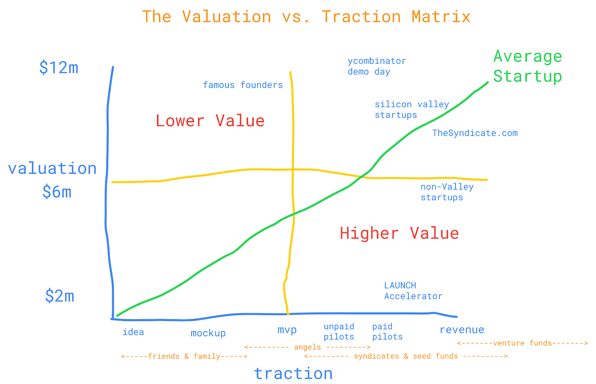
The Valuation vs. Traction Matrix – Jason Calacanis

Pasted image 0

Image from here :: The Valuation vs. Traction Matrix – Jason Calacanis

Great post. Will try to dive into it more later.

This is good though:

Startup valuations are not science, but they’re not magic either. It’s a bit of alchemy, combined with bizarre marketplace dynamics like famous founders getting 3x the price for half the traction, or Y Combinator hosting a gigantic demo day in order to create FOMO with novice investors who are explicitly told not to think things through and just cut a big check (literally, that’s their bad advice to investors).

Transactional Angst

I think nary a week goes by where someone doesn’t ask me how VC is going and when am I going back. I guess back means to return to building something, joining a company or working on a product.

It’s normally something that requires a longer answer but usually I say ask me in 10 years. That’s cause it will probably take me that long to see if I am any good at this VC thing. 

That being said I think people ask this due to the very nature of VC being somewhat transactional and maybe building something is more of a co-op approach since there are teams involved all working together to ship. It is a sentiment I think about a lot.

Saw this tweet the other day and was thinking about it even more:

https://twitter.com/joshelman/status/1109497183445803008

However I always consider that there may be a better way but I am not saying I discovered it but highlighting that each and every craftsman in the world can approach their craft with a new frame of mind. With VC I think about what that means often. 

Let me run down a few areas I think as a VC I can be more like the product person still living inside me:

  • Be open and transparent. Of course not everyone reacts well to this but I find a certain amount of it works
  • Be humble 
  • Be helpful
  • Have empathy for the founder and the other people/organizations in the mix
  • Try to write often enough so people can see what’s on my mind and how I feel about something
  • Continue to focus on doing the right thing – it may not payoff immediately but I believe it will win in the end
  • Learn to listen more – speak less. I am terrible at this but I am very conscious of improving it. That’s a start right? 😉
  • Foster an ecosystem since everyone will benefit (https://alpha.seedplus.com)
  • Be company friendly. This is a long one to explain but I think the right folks now what I mean

I don’t intend to go back as some people call it since I think I moved forward while still getting better at my craft. I see my craft as helping build great companies by being their investor and whatever else they need me to be while I am in that role. 

Pretty sure that is similar to what I did as a product person but I am not an employee or a founder.

However the North Star feels similar to me.

Your mileage may vary.

Life In A Constant Stream Of Emails And Meetings – AVC

Life In A Constant Stream Of Emails And Meetings – AVC

Very true – unfortunately.

Here are some of my tools/processes:

Internal meetings I used a laptop and just pound out notes linked to calendar entries using https://agenda.com

External meetings I use a notebook – I want to be in the meeting, not in my phone or laptop.

Most of meetings I let Evie schedule but I block of lots of time that she can’t schedule so as to make room for myself to think

I have been using Zapier to dump all my calendar entries into a spreadsheet – data mining for the future.

I have a bunch of inboxes and snippets for superhuman – on the desktop, which I prefer for work using a MacBook – I am incredibly efficient and fast with my email now and my inbox is not zero but very small. I don’t care about zero really but I don’t like a wall of email.

This forms the basis for most of my day to day processes.