Interesting stuff I learned

Yesterday while hanging out at my kid’s taekwando lesson I started to chat with another parent about what they did in Thailand. Normally I keep to myself, watch the kid and get some reading in but I tried to branch out a bit this time.

So what did I learn.

This gentleman moved from India to Rayong to help with a factory that builds the giant machines that can extrude aluminum into the aerosol cans used for sprays and deodorants. It’s a giant machine that on one end can take the aluminum and at the other end kicks out the painted can. At this point the cans can be shipped to be filled for retail sale.

It takes this factory team 8-9 months to build one machine. They assemble it in Rayong and then test it for production usage. Then they dismantle it into 80-90 crates for shipment by boat to anywhere in the world.

Then they send a team to re assemble it, test it and turn it over to production usage.

This company can only make 2-3 machines per year and it turns out a large Japanese company in Sri Racha owns like 20 of them.

Was fascinating.

I may ask for a tour next time I see him.

Sometimes Thailand does amaze me.

Koprol – The Inside Story. Part 2

Part 1 :: http://www.nokpis.com/2014/02/28/koprol-the-inside-story-part-1/

The path a company takes with the products and services they offer to customers is highly dependent on who is running the organization coupled with how the organization is constructed. At Yahoo this is no different but in my experience it might actually suffer a bit by how the company is organized at its core. This is an important topic to cover since this ultimately influenced how Koprol was managed – it also points to some of the core issues with Yahoo in general.

I must confess that I am 2 years plus out of Yahoo now with many of my good Yahoo friends already working at other companies. So my inside knowledge is obviously much reduced. This means I am going on what I personally experienced but from all outside appearances the overall structure of Yahoo has not changed much in the last few years apart from better food and phones.

Yahoo primarily is broken down into 3 distinct regions – America, Europe and Asia but there used to be an Emerging Markets group that covered Southeast Asia, Middle East and India separately. The HQ for that group was in Singapore which at the time made Yahoo one of the biggest players in the region and with a big head count in Singapore. What this meant was their was bizdev, legal, sales and even some product folks were aligned especially with the needs of that region. This can be seen as both a good thing and as a bad thing depending on the angle since this group would focus entirely on growth but at the same time the Sunnyvale HQ was not always supportive of the separate region. I think it was for the most part a good thing since it meant the team would move fast and try to evolve quickly enough to keep the region growing but Sunnyvale wanted to start reeling things in to make the company function better as a global unit. This was a tough time for the region cause it meant that SEA and India would now fall under APAC and the ME went to EMEA. Tumultuous times all around.

Once this decision was put in place the Singapore HQ started to let folks go and move people around to fit the new world order. This actually was a good start to get the region receiving more attention from HQ but it also meant a lot of changes. Looking back I don’t think this transition went all that well and might even be a good marker for the overall downward trend for Yahoo in some of these markets. However in a lot of places the downward trend was already happening anyway but I think what made the old organization unique was the ability to act quickly and make a lot of independent decisions. That autonomy was now gone.

For Yahoo Southeast Asia it makes sense to give you some overview of this org and the countries it operated in since this lead a lot to my decisions for where to focus my efforts on looking for small acquisitions.

Yahoo HQ for SEA was Singapore but also home to Yahoo Singapore. This group was a pretty good size since the revenue from Singapore was the largest when I was there even though the audience size was the smallest. This is important to note since it always made for an awkward situation of having to decide where to focus resources – on an area where the users are but not the dollars or where the money is.

Yahoo Malaysia was another proper office that had a small editorial team and sales. Yahoo Malaysia had lots of room for growth but there was always the issue of how much to localize and how to find the right mix to attract the local users. I didn’t spend much time there at all so I can’t really speculate as to how well it was or is doing but it was never really booming for Yahoo.

Yahoo Thailand was never really an office. Used to be some Thai folks would help to manage it from Singapore with some Thai content but it never really grew. When I was there I helped a few times, I didn’t lead the effort but was supportive of it, to try and push harder in Thailand. Anyone could look at the stats for growth of the internet and mobile internet and make a case for trying to take some market share. Problem was MSFT practically owned some of the market and Google was quickly taking over the rest of it. At some point in time Thailand was very Yahoo friendly with people advertising with their Yahoo email addresses or their Yahoo messenger ID’s but those days were long gone. Yahoo couldn’t make a valid case for trying to go back in and win. Yahoo Thailand looks like now it just points to Yahoo.com – so essentially they have given up on the place.

Yahoo Vietnam was one of the early success stories of going in with a local office and hitting it hard. The numbers looked good and the growth was good for a while but this came with it’s own complexities due to the rules in Vietnam. I won’t get into it much cause I am not a legal person but essentially once you setup shop in Vietnam with feet on the ground you are subjected to some level of government scrutiny and intervention. This makes is hard to really try and go big in the region. Yahoo’s work in news/entertainment is labor intensive and requires localization so it means that to build a great business around that you have to be as local as possible but that also means you are competing with truly local companies who might be willing to do what a multinational cannot. I will leave it at that. So Yahoo did quite well there but suffered some black eyes with the closing of some very local products and just dealing with trying to be a big local presence. At some point one could argue Yahoo owned Vietnam with products like Yahoo 360, messenger and email but I am sure those days are gone.

Yahoo Indonesia was another place the local org chose to focus on due to the size of the market, the relative openness around news and the fact that Yahoo seemed to get a warm reception from the population around Yahoo products. So Yahoo Indonesia became another decent size local office and there was even a lot of attention from Sunnyvale. Revenue wise though Indonesia was a tough nut to crack at the time. High user growth but low revenue makes for interesting times. At the present time I think Yahoo is fairing well in Indonesia but has lost a lot of employees and I think the competitors are beginning to cement a solid lead over Yahoo in many areas.

Yahoo Philippines also was a large local market with a decent size local office. This country was largely getting the same treatment as Indonesia since the brand was doing well there and the country was big. It had some of the same issues of needing to grow revenue but also to try and just grow the user base. The news/entertainment market was vibrant and fit well with the Yahoo suite of products. From what I remember, like Indonesia, the growth was good but Yahoo was beginning to lose share in some core products cause there was now competition in the marketplace where there was not before.

So with that background in mind I figured I would focus my efforts for scouring the region in Indonesia and the Philippines. Vietnam was out because it was too sketchy to put an engineering org there due to lots of legal issues. Personally I had a hard time connecting with Malaysia and just didn’t feel equipped to make a difference there. Singapore felt like it was going to be an expensive place to acquire and didn’t check the boxes for a place to expand engineering long term. Thailand was out cause we just didn’t have a big enough presence and with all my personal experience there – I just don’t trust Bangkok as a place to invest in. Look at current events to get a sense of that. I love the country but would I convince a large multinational to go all in – not with a straight face.

I even considered ways to look into Cambodia and Laos but the general consensus was Yahoo wasn’t going to try and expand the region. Keep in mind Yahoo was known for doing joint ventures to expand in some regions – this is how Yahoo Australia and Yahoo Japan were created. There was some people at the time who felt Yahoo should have done more of this. I tend to agree even though it is hard to create the joint ventures. Yahoo can offer brand, technology, and consulting – the other side of the venture brings local expertise, money and government connections. Many of us felt Yahoo could have pushed into a lot more countries with this model but it is probably too late now.

Small side journey – Yahoo was very early in all these regions and probably could have been a lot bigger if it tried to buy or build more things locally. I think this is the crux of the issue with the emergent markets versus the stable or developed markets. Yahoo’s core product suite wasn’t really appealing to the emerging markets young generation and if the region was left alone quite possibly the strategy would have been to build products, acquire, partner or white label whatever was needed to try and win the region over for the long haul. Instead what become the strategy was to take whatever Sunnyvale made and try to shoehorn it into the region. Not sure anyone can answer what would have been the best thing to do but if it were up to me – I would have probably tried to tweak for the local market as much as possible. This is what Yahoo did in Taiwan and for the most part it worked however the strategy stopped at some point and it looks like the market share in Taiwan is falling. I don’t think it will be like Korea where Yahoo made a full retreat but I doubt it will return to its former dominant position.

Deciding whether the global command and control technique of building products for the globe is better than localizing for the region is an age old question. If one looks at facebook or google you see very little localization apart from language and for those companies it has worked. Yahoo for a long time was straddling both fences of localization and global products but not doing either well. It seems under the new regime it is going to be back to global products with language and content localization. It remains to be seen what will turn Yahoo around at this point. My opinion is the the current management is mostly focused on the USA and to some extent Europe while waiting to capitalize on the Alibaba IPO. Apart from the core aspects of Asia it seems me Yahoo is now withering on the vine some in places like SEA and India.

Part 3 :: http://www.nokpis.com/2014/03/04/koprol-the-inside-story-part-3/

Khao Khitchakut – a non religious take on the journey

I stated last week I was heading to Khao Khitchakut. We did go and what a day.

I don’t see a lot of how to and such written by Farang so I will try to do my best here to help point the way and explain the process.

First off we stayed at FaaSai Resort – not the closest place to stay but we wanted to be near the ocean chilling out. The day before the trip to KK we did some driving around to familiarize ourselves with the area and roads. We even made a stop at Wat Khao Sukim which is a fun outing as well.

From a driving perspective you just need to use Google Maps and head towards Wat Khao Sukim and then follow the signs to where to park for Khao Khitchakut – basically you will come off of the main Route 3 – sukhumvit and either hit route 3322 or 3249 but once you are close to Wat Khao Sukim you will see signs directing traffic since there is only one way to get to the parking area where it all starts.

Sunrise at the base of Khao Khitchakut We started our morning at around 3:00 AM but the gods were not with us that early. First issue we ran into was having to wake someone at the resort cause the main gate was locked and we could not drive out. That took about 20 mins and set us back from our early departure some.

Next issue was none of our phones worked. There was no data signal and at times there was no signal at all. We use TRUE and none of us had data – so that meant the maps wouldn’t work. Fortunately I had been using Google Maps and a lot of the route was cached from the day before.

Road were very dark though so it took some u-turns and such to finally get there. All in all we made it to the main parking lot about 1 hour later than we wanted but was still dark. By the time we took the first truck to the main area the sun was just coming up and the sky was gorgeous.

Since there are so many people coming to this event and the mountain is only open for about 3 months – the scale of the operation is pretty impressive. We got to the first parking lot where there was food, buddha supplies and drinks. This is where you pay the 50 baht to get in the back of a truck and are taken to base control.

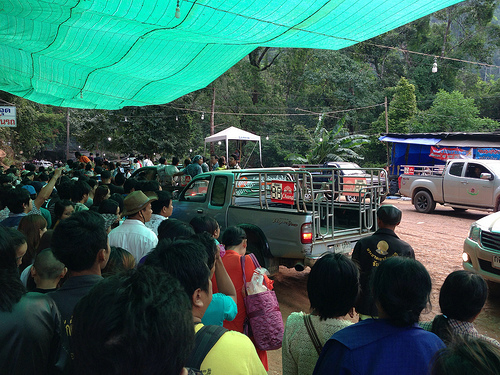
Truck loading at Khao Khitchakut

At the base is where there is a ton of food, lots of shops, and just a huge operation supporting the entire ordeal. There is even a gas station for all the trucks that ferry people up and down the mountain. The main thing at the bottom base station though is to quickly buy your tickets to get to the second base station. The tickets are 50 baht each as well and are ordered by number. So the sooner you buy one the sooner you get in a truck.

Like an auction house there is a Thai guy calling out numbers of trucks and which ticket numbers are associated with each truck. Basically once you hear your number and a truck number you jump in if you can fit but sometimes you get in the next one if you have to.

The ride up is nuts. Tough to explain or capture it well. Here is a video just to help set the stage some. I am still not clear who organizes this entire event or who manages the trucks but I think there are a few hundred trucks – many of them new. Toyotas, Isuzu, and Fords mostly. They are owned by some management company that also pays the drivers. They drive pretty fast since the goal is to move as many people as possible. I was told there have never been any major accidents cause the drivers are kind of trained and work the mountain every year.

The road is very steep and can be quite narrow but it is also very twisty. So sometimes the trucks are on one side for a particular turn or on the other for another one. They have signs that show them which angle to take and the trucks cross each other going up and down. It seems quite daunting as a passenger but it all works and is fascinating to watch. Once you get up to the second station you buy another ticket to get the rest of the way up and to the base of the trial head.

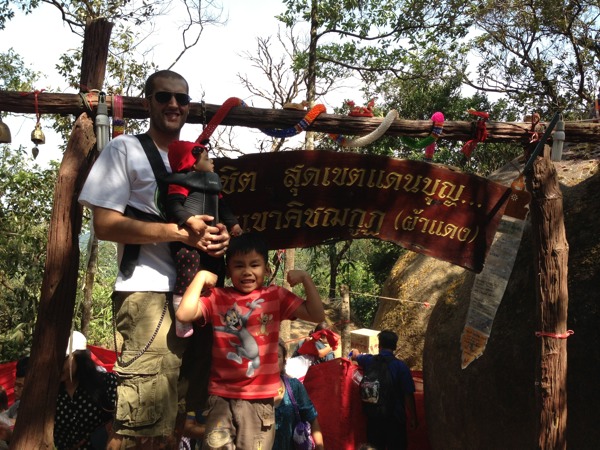
Khao Khitchakut Trail Head Once you get to the top is is madness with everyone buying stuff for buddha offerings and people jostling to get going. At this point I had no idea what was to entail. I assumed at this point I was close to wherever it was we were going but this is actually the beginning of the walk. My iOS to track all this was not working well due to location and lack of 3G most of the time but I estimate from this point we walked about 7-10 km and spent roughly 4.5 hours walking up and down to get to the actual end of all the walking.

Along the way there are various stops that have some religious significance – I can’t recall if we stopped at all of them or not but we managed to take in quite a few. What really stunned me though was not only how many people were on the mountain but the amount of shops selling things. Keep in mind they also had to bring their stuff up by having it carried up.

Throughout the trip you would see people carrying stuff up and down – bringing items and food in – taking garbage out. I think for these people that was their job – carrying stuff up and down the mountain. It looked liked the most back breaking work one could imagine. I was tired from just carrying my fat ass up and of course I had my daughter strapped to me which meant I was carrying an extra 9 kilos or so. The great thing was constantly getting a kick out of all the people who were surprised to see her make the journey. She loved every bit of it.
For those who do not wish to make the journey by foot there is a service for taking people up and down the mountain in a chair. I think it is 2000 baht for the ride up and down. 4 guys using a chair with support poles. You would see these going up and down the mountain all day. Mostly used by the elderly and people who are physically unable to make the climb.

Chair up Khao Khitchakut

At this point we had reached an area that I thought was about to reveal the end of the journey. The path was getting quite cramped and was full of bells and other things so it just felt like maybe this was getting to be about the end.

Narrow Path on Khao Khitchakut

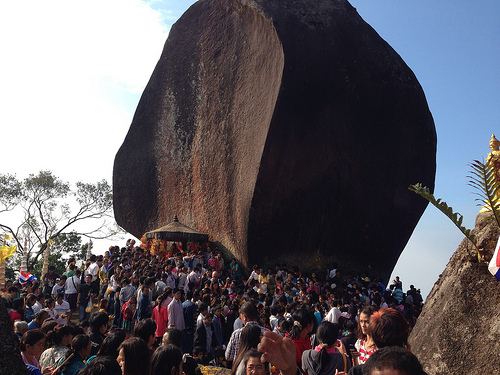
However it turned out that this was about halfway and it was nearing the apex of one of the holy spots with a temple, lots of people and the famous rock on top of the mountain. This area also has a heli pad which I guess is used for emergencies but someone also mentioned some people pay for a helicopter to get them to this point. Nice!

Big Rock on Khao Khitchakut

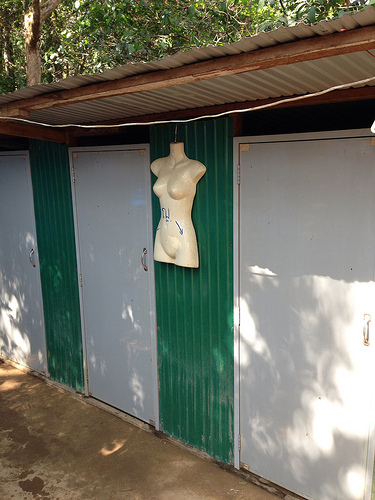
This rock is the main one for people to worship at but it turns out that if you want to go all the way you keep walking past this – and we did. At this point I was just on auto pilot. We came across another famous spot and then stopped for some food that is served near the top. Changed a diaper, got some water and took a bathroom break. Can you guess which toilet is for the women?

Women's Toilet

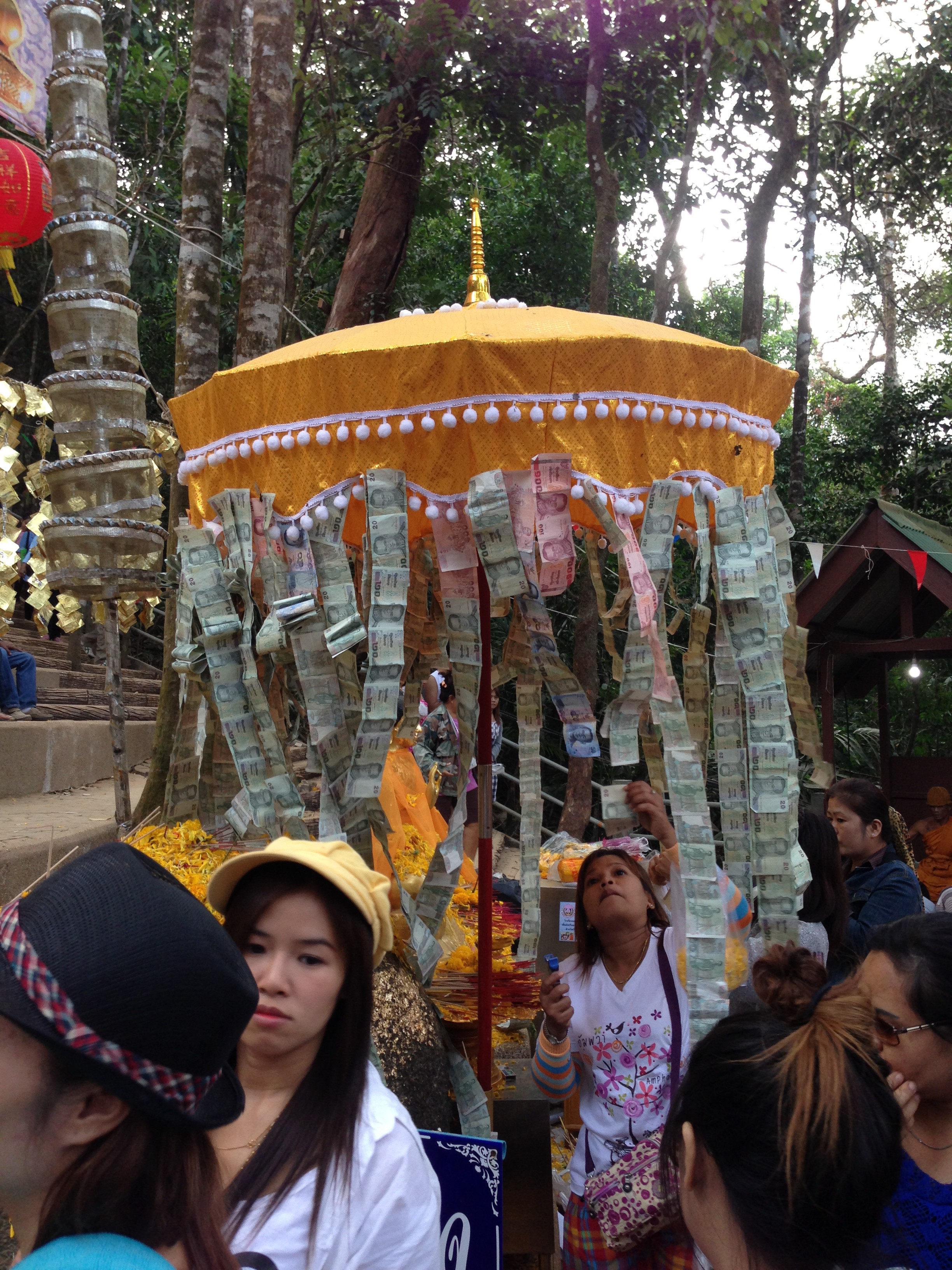
To be honest I am not sure at each step what the religious significance was. At certain points there were monks, shrines and various natural things that would draw a crowd. You would also see many places for donations – like these umbrellas. My guess is the money intake during this is enormous.

Money Tree

At one point you will think you have to come to the end of it all but it turns out the trial keeps going down the mountain to the very end. We made it all the way and I estimate going to the very end to be about 5km of walking to about 10 or so there and back. This article mentions some of the distances, the things along the way and of course the famous Buddha Footprint which I don’t think I got a picture of.

All in all was quite the experience. Not sure I will do it till my daughter could walk since carrying kids is tough – more fun if they can walk. I would also start earlier – try to get to the mountain before sunrise so you see the sun coming up and the walk is cooler. Also be sure to keep an eye out for the shortcut on the way back – just remember that the food stop has a back way where they bring supplies in. Means you can get down to almost the bottom by using a back way that is mostly for supplies and people going down. Saves you some time since some of the paths come to a dead stop with so many people unable to pass each other.

Once you make it down I suggest stopping for break to grab a drink and some food since the truck ride down might be gnarly if you are tired and on an empty stomach. Once we got back to the main spot you then need to get another truck back to the parking lot which was free for the return. Then we grabbed some noodle soup before heading back to our hotel to swim and nap.

Enjoy!
Heading to Khao Khitchakut (Kitjagut)

Thai transliteration is never perfect so not sure if it is Khitchakut or Kitjagut. I have seen both spellings.

So the great thing about where we live is easy access to Chanthaburi Province – nice mountains, beaches and cool sites to see.

One of the many things I have wanted to do is visit the holy mountain with the crazy Buddhist rock on it. It is only open 3 months out of the year and is quite the mad house of people.

So that is the plan. Not sure how it all works yet but hopefully the force will be with us.

Plan is to stay at a new place, Faasai Resort and hit the spa.

enjoy the weekend!

If only Thailand had a clue…

I love Thailand. Have since the moment I first arrived for a business trip. The chaos, the city of Bangkok, the mountains, the oceans, the people, the food and this list can go on and on. However the place is not without it’s issues – just check this article for the silly reaction to a skit on SNL making fun of the sex biz in Thailand. I won’t get into how the biz is mostly run by and for Thais and is ingrained in Thai culture. Plenty of interesting books on the subject if you think I am off in left field here.

However I digress. Thailand has so many positive points but the country usually gains notoriety for its problems and usually these problems are self inflicted.

So that being said I am continually amazed why Thailand doesn’t quickly and decisively leap frog most of SEA by going for the Gold in the startup olympics. There is a startup fever in SEA – the HQ for this is Singapore but we all know the place is getting way too expensive. Many folks decamp for Malaysia or even work in Singapore and sneak across the border to live. Lots of folks setup shop in Indonesia which works for some but Jakarta traffic and lack of transportation infrastructure keeps folks like me out. Vietnam is cool and all but it is too much a mini China for me with the censorship and the government protection racket for incumbent companies.

So back to Thailand. It has issues. Freedom of speech, censorship and some others I won’t get into to. All in all though Thailand could be a great hub for SEA startups but the funding scene, the work permit and company issues tend to drive out anyone but the locals from really making a go of it. Sure I know there are startups in Thailand not started by the locals but there are plenty of stories from those who have tried and promise never to do it again. Some of those folks still work and live in Thailand but don’t form companies and legally stay via marriage or education visas. All good but not really the most convenient.

So when one see what Canada is doing to get startups to come to their country – I silently dream about Thailand doing the same thing. I know it won’t happen but it is possible and it would radically change the SEA landscape since Thailand is a good place to live, has talent and is starting to attract lots of hip people who just want to be here ( I know an investment banker thinking of jumping from Singapore to Thailand cause he thinks it might be a better city to live in for a while) but startups face such an uphill battle to be legal in Thailand if they are not founded by Thais. I won’t even get into the inane work permit requirements, the silly annual audits and all the other red tape that is death to a lean startup machine.

I will keep dreaming. Hoping that maybe someone in a big meeting room somewhere in some part of the Thai government decides to get radical.

Edelweiss Fondue House and Restaurant :: Pattaya, Thailand

With the parents in town I figured it was time to try some place new – so last night we hit www.edelweissth.com. It is located at Thap Praya Road Soi 13.

It is a converted house with outdoor and patio dining. Speciality is Swiss food, cheese Fondue and I guess what you would call meat fondue as well. We ordered 3 platters. 1 was the cheese fondue and bread. The other was sliced beef platter that you cook in a broth – the third platter was cubed meat that you cook in oil. Each platter came with soup and salad bar which was quite simple but tasty.

I had a glass of white and the parents had soda and a water. Total bill was like 1500 baht and we were absolutely stuffed. Everything was tasty – tables were small so was hard to manage all the burners and food but still was quite enjoyable. We ate on the patio with a cool breeze and great conversations.

Looks like the owner is always around and is there to make sure everyone has a good meal. I plan on going back to try something else and of course have another cheese fondue.

Baan Imm Sook :: Chanthaburi, Thailand

The great part about NOT living in Bangkok for me is that within a few hours I can get to some nice places to stay. Sure people can trek down to Koh Samet or do the Hua Hin circuit on the other side but generally these are busy tourist places and I like to avoid the tourists when I can. Chanthaburi Province is not a bad escape – quite a jaunt if you live in Bangkok but not so bad if you are coming from the Pattaya area.

Some of the places I have stayed:

http://www.chivareehotelandresort.com/ :: nice boutique spot. Good huts, pool and nice bar and food. Fills up a lot with private parties, weddings and special occasions.

Another fav of mine is :: http://www.baanimmsook.com – nice bungalows with a deck, easy walk to the beach and a cool laid back escape feel. No pool or restaurant but they serve breakfast. I just love the cabins though and tend to hang on the deck when not at the beach.More info.

Smile Beach Resort is another one. Decent rooms, pool and a nice location. More info.

There are a few restaurants (nothing fancy), a coffee shop, and some mini marts in town. Nothing real upmarket but there are some bigger resorts like http://www.chaolaoresort.com but I tend to enjoy the smaller ones.

Hanging at Baan Imm Sook and will write up another post if I see some other sites worth checking out.

Car Rental :: Pattaya, Thailand

For a while in Pattaya I didn’t have a car so would rent when we wanted to go somewhere or needed to move stuff. I still rent when I need to move stuff.

http://www.thairentacar.com

My go to rental place is Thai Rent a Car. Reasonable, online booking and never have had trouble. Sometimes they just don’t have a car available. They have a center at the Outlet Mall on Thepprasit Road and they also allow you to pick up and drop off at the Bangkok Airport – the real one. Not the downtown one.

http://www.pattayacar-rent.com

Used this place one time. It is also reasonable, decent selection and nice peeps but every time I try to book now they never have a car. So I stopped even trying to rent one here.

http://expatcarrent.com

This is a new one I am trying. My parents are coming to town and we need a bigger car for a few weeks. I did the booking via email and will let you all know how it goes.

Red Bull Story

20110522-014228.jpg

I always find it fascinating reading about the Red Bull drink – since there is Thai folklore, rags to riches and just an incredible story of an unlikely product that makes a ton of money.

I think a can is made for like 5 cents and sells for many times that. The Thai family behind it is one of the richest in Asia and here you can read about the Austrian who made it all happen:

Little known outside of his native Austria, Dietrich Mateschitz is one of the most successful entrepreneurs of our age, a man who single-handedly changed the landscape of the beverage industry by creating not just a new brand but a whole new category: the energy drink. As the visionary who brought the world Red Bull, affectionately known as “speed in a can” or even “liquid cocaine,” Mateschitz, 67, has been a patron saint for more than two decades to late-night partiers, exam-week undergrads, long-haul truckers, and, above all, extreme-sports athletes everywhere.

In return for his sickly sweet innovation, the world has made him very, very rich. Last year the privately held company, also named Red Bull, says it sold 4.2 billion cans of its drink, including more than a billion in the U.S. alone. That represents a 7.9 percent increase over the year before, and revenues jumped 15.8 percent to $5.175 billion. Mateschitz runs an efficient enterprise that has yet to trip on its rapid growth: At the end of 2004, he had just 2,605 employees; in 2010, Red Bull employed 7,758 people—which works out to more than $667,000 in revenue per person.

I am no language expert but pretty sure the name in Thai simply means “red bull“:

A chance trip to Thailand in 1982 would prove to be the turning point in Mateschitz’s life. Curious to know what attracted the locals to an uncarbonated “tonic” called Krating Daeng (Thai for “water buffalo”), he tried some himself and found that it instantly cured his jet lag. Not long after, while sitting in the bar at the Mandarin Oriental in Hong Kong, he read in a magazine that the top corporate taxpayer in Japan that year was a maker of such tonics. Suddenly, the idea hit him: he would sell the stuff in the West.

I also love how honest this guy is :

He’s close to some of Austria’s most prominent people, though Mateschitz says he doesn’t place a premium on collecting friends or socializing: “I don’t believe in 50 friends. I believe in a smaller number. Nor do I care about society events. It’s the most senseless use of time. When I do go out, from time to time, it’s just to convince myself again that I’m not missing a lot.” On those rare occasions, however, he invariably arrives with an attractive woman on his arm. “It’s just that I’m not old and wise enough to be married yet,” he says. “But is it necessary that you write about this?”

Impressive dude:

Despite the fact that he’s approaching 70, Mateschitz maintains quite a clip. He still moves like an athlete, rides horses, pilots planes, and last year competed in an off-road motorcycle race. He has, however, installed a board of directors at Red Bull to work on broader strategic issues. Red Bull now has hundreds of competitors (the latest entrant: Tiger Blood energy potion, an homage to Charlie Sheen). For a time, there were rumors that Coca-Cola had offered to buy the company, but those have died down. Mateschitz has long insisted that he has no plans to sell or take Red Bull public. “It’s not a question of money,” he says. “It’s a question of fun. Not only that, can you imagine me in a shareholders’ meeting?”

Impressive story…