Isn’t every startup like a platform?

Great article, looks to be a series I think, about platforms. This is from Ryan – ex twitter exec.

http://sarver.org/2013/09/26/what-is-a-platform/

I guess my angle here is I tend to think of any startup as a platform. It may not be that it fits the exact description for how the tech industry defines a platform but I like to think of the problems I work on as a platform play. It helps me in taking the long view since I think unless you are incredible lucky, like 3 year old instagram, most startups will be at it a while.

As I like to tell people – it’s a marathon, not a sprint.

Most platforms take the view of apps or software stacks that are available for developers to build on and the effect of this creates a network effect to further drive the platform. So iOS, facebook, twitter, microsoft, android and others are listed by Ryan as examples of platforms under the common agreement for how platforms are defined. All good – I won’t argue with that premise.

But when it comes to building your startup, no matter what it is – I think this platform methodology can help you define things to work on and focus on. I like this line:

This created a very powerful network effect that drove growth of both sides of the business (developers and users) where growth of one side directly benefited the other.

I think about how the growth on one side directly benefits some other side of your startup. So if you think of all the sides or facets of your startup – you can think about how work on one side can directly benefit another side – find ways to see if the network effect is at all applicable to your startup.

So when I think of spuul – I think of it as a platform for India video consumption and all the sides of the business are broken down in ways to allow me to see the overall product as a platform and to then focus my efforts on figuring how the sides of the platform can feed off each other.

Product management means many things to many different people – I will talk about my theory on it all later – it more closely resembles chaos theory than anything super organized. I realize that breaks a lot of know product management constructs right out of the gate but the craft, yes it is a craft, of making a digital product is an evolving field with many different ways to skin the cat. If I look at all the ways to skin a problem – looking at my product as a platform helps me to focus my efforts.

Looking forward to more from Ryan on this subject and seeing where I can apply it at work.

Also going to read this :: http://mitpress.mit.edu/sites/default/files/titles/content/9780262050852_Download_the_full_text.pdf

back to work…
Discussing lean…

Since I am working on 2 startups, spuul.com, and the munchkin – I rarely read enough these days. I want to read. I instapaper a mountain of things, I have a stack of books, but generally by the time I have worked, spent time with the family and get through a weekend Financial Times – I am out of time.

However when I came across this, I have made the time to even read it a few times. There are so many angles and thoughts to cover in it. Not even sure where to start.

The one thread I am picking up on and sometimes would agree is the discussion about the Lean Startup movement and it’s impact on the world’s startups:

For an opportunist, it’s all about speed. Get the product out there as fast as possible to start gathering feedback and iterating, then iterate as fast as possible, pivot when you’re not seeing enough traction or when you have a better hypothesis, and give up when you don’t think it can work anymore, or when you run out of money.

If it doesn’t work out, opportunists are not going to double-down and throw good money (and time) after bad. They are honest enough with themselves to acknowledge check-mate. Or, as our Anonymous Founder put it, when they’ve “run out of moves”. There’s any number of things that may have gone wrong. Self-reflective opportunists learn from these mistakes. Either they misjudged the circumstances, or executed wrong, etc.

The Anonymous Founder is an Opportunist. I’m not even sure it was a conscious decision. He is the product of the culture of Silicon Valley, a culture that the Lean Startup Movement created.

The Lean Startup Movement has been the dominant school of thought in Silicon Valley for too long. I am an outspoken critic, because although it has given us a valuable tactical framework, it has removed from the conversation casus belli. For years now, Silicon Valley has talked of nothing but battles, and forgotten about war.

Now, we have an imbalance in the ecosystem. Visionaries are few and far between. There would be more, if founders followed their instincts, but they get drilled into the dogma of the Lean Startup. Which is fine, if you want to build a Lean Startup. But not if you want to build a big one.

The Lean Startup has taught us, wisely, not to be too attached to how we do things – to allow more room for qualitative feedback and data-driven experimentation in our development process. But it has also brought with it, unfortunately, a culture that discourages founders from becoming too attached to why we do things.

Starting a company is like going to war. You are declaring war on the status quo. War is costly and painful. Why would you do it?

Powerful thinking. It is not really that I am against the lean methods or the Lean Startup but sometimes I think it can become too formulaic and might lead people to lose a little of their passion. Not to say you should work your ass off on a dumb idea or one that bears no fruit but sometimes I think that based on your experiences, your team and your leaders that you might just have to stay focused to see something bear fruit. It might take time, it might be painful and it might not come with everyone patting your back but if you think it is the right thing to do, if your internal stats are showing some progress – then you might be on to something.

It still might take time. This means that all of your learnings might not be easily or quickly validated or disproved but being on the inside you should see some signs from your stats and customers that you are getting warmer or maybe you are getting colder. Sometimes you might have to make a gut call or a fly by the seat of your pants decision. This is how it works sometimes. This is what makes it fun and exciting.

For me it is like Lean Startup++ . Somewhat modified so that I take some of the best lean ideas, marry them with my experience and then combine them with the passion from the founders/investors to create something that I think is better but maybe not as easy to diagram.

Lots to think about. Lean or not. You have to just do it.

It’s an amazing time to be in the startup scene…

I have a longer post  I want to write about the local events we just had in Singapore and about the role of a connector but that will have to wait.

As an aside – read this: http://breezilyapocalyptic.tumblr.com/post/51271488195/change-the-world-silicon-valley-transfers-its – heavy, but largely accurate in my opinion. Hat tip to http://www.isouweine.com – who is leaving Singapore soon and I will miss him a ton. 😦 Anxious to see what he gets up to in his new home.

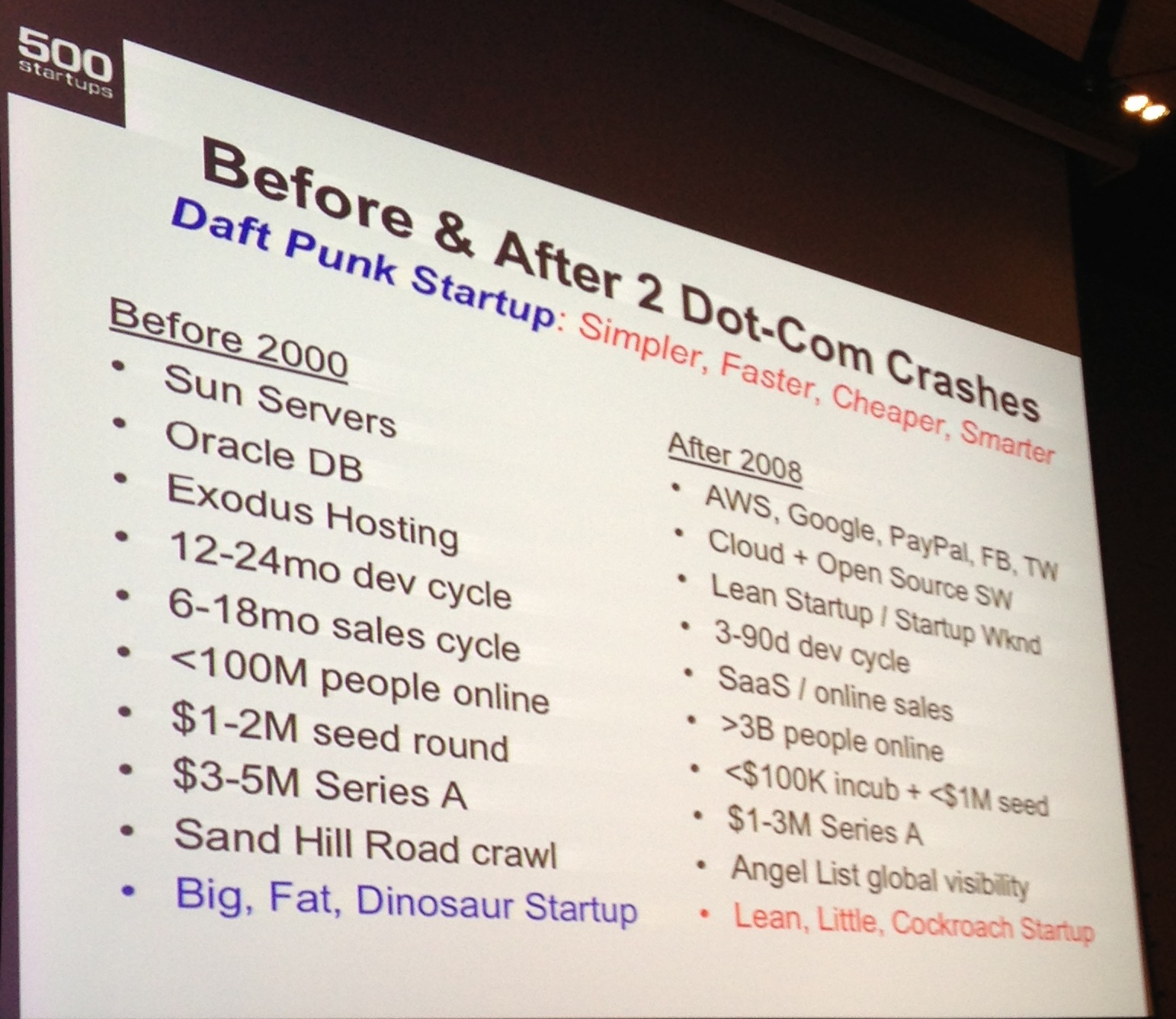
So at Echelon I snapped this slide from Dave McClure :

before_after

I am dating myself but I lived through the before 2000. Worked at a startup that had to spend most of our money just to turn on. We needed to buy Informix database, ATG app servers, Sun servers and racks in a hosting center – I think it was Consonus or something. Point being it is so much easier now. Grab your idea, some time to build it and give it a shot. Of course the competition is also stronger than ever and building a viable business model is not easy but at least it takes less hard capital than it used to.

It is a good time to be in startup land!

good luck.


Google vs Apple plus some extra video thoughts…

Was in the states for a whirlwind trip. San Francisco, Alta, Boston, and then Brooklyn. BTW – domestic US air travel still sucks but doesn’t seem as bad as it was.

Jetblue works well for tooling around the states.

Met up with a ton of peeps for work and to catch up with personal contacts. Was great to see all of you – I think my parents are still talking about their trip to the new Twitter HQ. Good times.

While I was in the states Google had their I/O conference. There were lots of little updates but I was mostly looking at the mobile stuff. I get a sense that things are going to change with Rubin being pushed out. There are the things you hear at the conference and then there are the rumors you get from your own Google network. Mine is telling me that Google is going to push on Chrome, like they are with Pixel, and eventually down play the mobile OS. The idea being that all you need is Chrome. It might work but I wonder how things will function in the mean time?

Given I work at Spuul – I am all about video and Android is a terrible ecosystem for video when it comes to being able to build a reliable streaming solution that is secure out of the box. Apple figured this out early with eHLS while Google pretended that open wins – but content producers need open and secure. Not just open. Since I was in the city I stopped by to hang out with the amazing zencoder.com folks and whilst in Boston I attended Brightcove Play. I could get deep into this but the main gist is that possibly the world will begin to centralize on some sort of segmented streaming standard like MPEG-DASH but with some hope of securing it. Please note that DRM is one thing – securing the stuff we pay to stream from lame people stealing it outright is another. I could care less about DRM – I just need to protect my business. A new standard might be all well and good but who knows what Apple will do. So far is looks like Apple and Google are facing off around video versus cooperating but that makes sense in general but maybe someone like Netflix can help influence.

Will be interesting to see what Apple talks about at WWDC since Google mentioned a few things around video and their codecs but nothing to deep around DASH, widevine or any ideas on where it is going. The fear is Google might just work on making Chrome, Android and YouTube better versus making the ecosystem better but of course Apple could be accused of the same thing. However HLS is turning into some sort of default cross platform standard since many people are using it outside of Apple.

Back to Google. In general I am impressed with their Android tools for the Play Store. Being able to reply to user comments is awesome and I think helps shops like us to dialogue and respond to users. Without this the app stores are a jungle and just a pain to deal with. Google also is doing a lot of good work around payments and we shall see how OPEN they stay around alternative forms of payments in the apps. Something Apple has zero openness around – zero. Google seems to have shipped some great stuff with the new IDE to help all of us ship and test better apps. The new managed beta thing looks super useful as well. Although building for Android is a pain – Google continues to improve it.

Thinking about WWDC coming I am hoping Apple will fix some things.

– Please allow developers to respond to comments. Your app store also is a jungle as well and not being able to respond to users sucks

– Please stop protecting iTunes and allow us to use in app purchase to rent, sell, stream or do whatever we want that the users want. Outright preventing companies with legal content from creating a rental platform is silly. You afraid of the competition – you should’t be since you get your 30% anyway.

– Open up Apple TV so we can build on it and allow us to use the payment hooks – plus fix the above item as well

– Give us the tools for large managed betas via the app store

– Allow us the ability to include alternative payment methods providing we also put front and center Apple payments as well

– Fix the app approval process. Sure – first time apps should be reviewed. Updates should not but create rules around what happens if a developer willfully does an update that is against the TOS. You have lots of money – spend some of it on addressing this issue so we can ship more and make the world better for users – most of us want to do right by the user but we always have one hand tied behind our back by Apple.

– Try to address the web video standards by throwing your weight around more – we need the new enhanced HLS. Make it something cross platform. Shake Google up some.

I am sure, like others have, that I could make a big list but I think I will keep it focused to the main stuff.

I will be watching WWDC and hoping to hear some good news.

ps. I played with Google Glass. Interesting stuff.

Learning from the masters…

I had the fortunate opportunity when I was first getting into tech to work at Weblogic – a lot of people don’t formally talk or write about it but many of the people who worked at weblogic (and BEA after BEA acquired it) are some of the superstars sprinkled around the tech scene. Twitter, Google, Salesforce, Facebook and lots of smaller companies all have senior people that came from Weblogic. Don’t ask what happened to me – I snuck off to Asia while the valley boomed. 😉

Anyway. I keep tabs on a few of these folks and always find I keep learning from them.

Back in the day I was in Sacramento working at Examen, Inc. which was trying to disrupt the medical insurance industry. At the time I was looking to build a new platform for them in Java and stumbled across WebLogic JDBC drivers. As I was dealing with their support I got to know Paul. Yes – Paul being one of the founders of WebLogic. Long story short – Paul got me down to interview with the team in hopes I might join as a sales engineer. I was techy, could talk and loved to travel. I thought I was home free until I had my one on one with Bob Pasker – the other founder of WebLogic. Bob proceeded to dress me down technically and I figured it would be best if I walked out and saved what little bit of dignity I had left. Bob is a brilliant techy and like many of the WebLogic folks – could code. Me – I was just passionate, could whiteboard well and could NOT code. Paul told me not to worry and to meet Scott. Yes – that is Scott Dietzen of WebLogic, Zimbra and now Pure Storage fame. I thought I had a good chat with Scott, who was the marketing guy at the time, but it turned out he nixed me. Scott eventually came around after a few years and I thank him immensely for the tricks he taught me. Bob and I also spent many a year together selling WebLogic and I still remember all the stuff I learned from him.

I did manage to get hired and to this day I look back on my WebLogic/BEA days as one of the core pillars of my tech career. I always remind people that Karma is very important and to be sure to treat people well since you will also call upon those in your past while you carve your future. The reason I made it into Yahoo was because of guys like Scott and Sam (now a VC) – also ex-weblogic.

Some of the lessons I learned early on was how important customer support is – watching Paul the founder do customer support was so powerful. At Spuul I value customer support very highly and at the moment I handle most of it so I can be close to the customers. I remember going to some big sales meetings and would be joined by Scott and Bob working to close the deal and to show that even the execs/founders took customer support and sales quite seriously.

The big takeaway for me though is watching Scott in his new role and the way he uses the blog to battle the incumbents. Here is one of his latest posts:

Looking forward, I am often asked how Pure Storage is going to continue to win with storage leader EMC entering our market. The answer is straightforward:

  1. Build a better product – We have somewhere between an 18-month to 2-year lead. In tech, that’s about as much of a head start as you could hope for. With the deeply talented team we have at Pure, our aspiration is to grow our technology advantage over time.
  2. Delight our customers – Our endusers tell us we are providing the best service and support they have experienced in storage. Our job is to make it even better going forward.
  3. Leverage our partners – EMC has about 30% market share, and they do about 1/3 of their business through the channel. That means about 10% of today’s storage buyers get their EMC storage through a partner. That leaves 90% of the market available to Pure and our channel partners.
  4. Further distance ourselves from the rest of the competition – Our experiences thus far suggest that the barriers to entry for the all-flash array category Pure established in 2011 are well higher than for disk arrays (e.g., getting submillisecond inline dedupe and compression right).  Our prediction is that the all-flash array market will increasingly become on a two horse race between us and EMC, that is one that will likely serve Pure (and EMC) well indeed.

I always loved Scott’s ability to straddle tech, marketing and customer interactions. It is such a powerful combo and one that many startups seems to forget. After all – it is about the customer.

There is so much to learn about his 1 and 2 – it just speaks volumes. Build a better product and delight your customers.

Focus on that and you are mostly there already.

The other thing I learned from Scott was how he would change the playing field. Redefine the game to make it hard for the incumbent and favor the startup – almost like a slight of hand card trick. In the WebLogic days we invented the Java App Server Litmus test as a way of defining what was in an app server, what a good one excelled at and how WebLogic was the leader. Later on you might recall that the industry created J2EE and WebLogic lead the charge and was acquired by Bea Systems. I still fondly recall explaining J2EE to Bill Janeway and marveling at how his Timex watch was taped together.

I was lucky to work around all these folks and the many, many others at WebLogic and BEA. I still follow them from afar and take notes.