Freemium

I am trying to blog more this year but I also said that last year as well. What can I say – I try.

I read this on SplatF and mostly agree about not wanting to waste time on social but write more – even if in smaller chunks.

I love twitter though cause it kicks of nice conversations that spurn me to write something. Yesterday was no exception.

Thanks to Chris and Dave for the inspiration.

Here is the string of tweets :: https://twitter.com/myeggnoodles/status/420423888342749186

I think Chris is making a great point and one I have always subscribed to when I considered joining or building a startup. The business goals of such startup should be to generate revenue. Within this framework though I think freemium is an accepted model. Because some startups, Spuul for example, are building in an area where piracy is rampant and the user population in places like India or Pakistan is not accustomed to having to pay. Or maybe they want to or would pay but the payment methods are not there.

I think other business models also run into the same hurdles so offering a free to use product that strives to convert the free user into some sort of paid user is an acceptable model. In our case we are also putting an ad business around the free model so it will also generate revenue.

All that being said. This is hard stuff. A lot of what we launched with has changed. We offer more subscription tiers than originally expected. We had to learn how to upsell. Had to decide over time on which features to make free and which features to make available only to paid users. We had to learn how to not try and attract only free users but users who wanted to kick the tires for purposes of deciding for themselves if they would eventually upgrade. Meaning there is a big difference in marketing to get a free user and marketing to get a user who starts as free but has the propensity to pay.

Lots of work to sort all these flows out and to build a business around freemium but I think in emerging markets and for some business verticals – freemium can work.

The other school of thought says only build something people want to pay for. This for some business verticals might also be doable but it may not always work. Either way I think it takes time to do either of these well and at scale. Generally startups are rushed to sort this out and don’t have the time to experiment to see what sticks.

After all an early stage startup really is just an experiment.

happy building!
Crazy week in my World!

First up we have Rakuten buying Viki. http://blog.viki.com/2013/09/letter-from-vikis-ceo.html . This was probably be the biggest tech news for me personally. One I almost went to work there so I follow Viki very closely. I guess you can also say I am in the same space as them but much farther behind in our maturity but what happened to Viki is great for a startup like Spuul in Singapore. It shows the video space is hot, you can build something global from Singapore, exits can happen and that the dream is alive.

I am very curious to see what happens next to the company, who stays around and what Rakuten does with all these disparate pieces that are supposedly tied back into e-commerce. People say it is like Amazon or Netflix – not sure I see that yet. I can imagine the Amazon comparison but where is the cloud stuff? Either way Rakuten is a force and now Viki has some serious backing and is supposedly somewhat independent. All debating aside – congratulations to the Viki team for an amazing exit.

Next we have MSFT buying Nokia. This one can and will be debated till the cows come home. It essentially always needed to happen – why now? Is it about Ballmer stepping down and Elop coming home. I don’t know but I think MSFT has a huge uphill battle to make Windows Phone competitive but apart from them – it is all android and iOS, so I do hope MSFT can shake it up a bit cause it will be good for the ecosystem.

Stoked to be mentoring over at http://jfdi.asia this year. Should be fun and great learning experience for me.

On the Spuul front – we just launched our biggest TV deal yet :: http://blog.spuul.com/2013/09/star-plus-serials-now-available-on-spuul/ . Lots more coming as well.

All in all an exciting week locally and globally – now over to Apple for next week!

Being a connector

Sometimes apart from my main gig and my blog – I am not always sure what my role is in the startup scene. I don’t have time to actively attend lots of things and I usually am probably too busy to actively mentor but I do try when I can. However I do a good job of remembering people, I try to add everyone to my Linkedin so I can keep track of them and I usually remember what people are doing.

So lately the role I think I have been playing is connecting folks. It may not be super glamorous and there may be nothing in it for me but I think that is okay. Too many times people always want something out of doing something for others but I enjoy the giving – I think life and career are full of karma like moments. I am pretty sure I got to where I am today by the people I know and the things I was able to do. Maybe had I thought about karma even more I would have come even farther. Tough to say.

My point is though we can call help each other by connecting folks who need something to folks who might be able to help. Through the connection maybe someone progresses further than they would have without the connection. Sure – maybe there is tech to solve this problem but I think the human touch makes it more fun. Of course my intro might be via email but that’s okay.

Recently I was rewarded for my connection actions by meeting someone at MediaCorp who was asking about the startup scene for a segment they were working on for live TV.  I decided to email all the folks that I thought this person should talk to. This lead to me being invited onto the segment – which I was surprised but grateful for. Of course then I wore my Daring Fireball shirt which lead to a gruber tweet. So the whole circle was perfect. I gave and I received more than I gave. Karma.

The SEA startup scene is small but growing. We will compete with other startup locales but we can beat them all handily if each and everyone of us plays the role of a giving connector when it makes sense. Connecting all the dots will helps us all succeed.

It’s an amazing time to be in the startup scene…

I have a longer post  I want to write about the local events we just had in Singapore and about the role of a connector but that will have to wait.

As an aside – read this: http://breezilyapocalyptic.tumblr.com/post/51271488195/change-the-world-silicon-valley-transfers-its – heavy, but largely accurate in my opinion. Hat tip to http://www.isouweine.com – who is leaving Singapore soon and I will miss him a ton. 😦 Anxious to see what he gets up to in his new home.

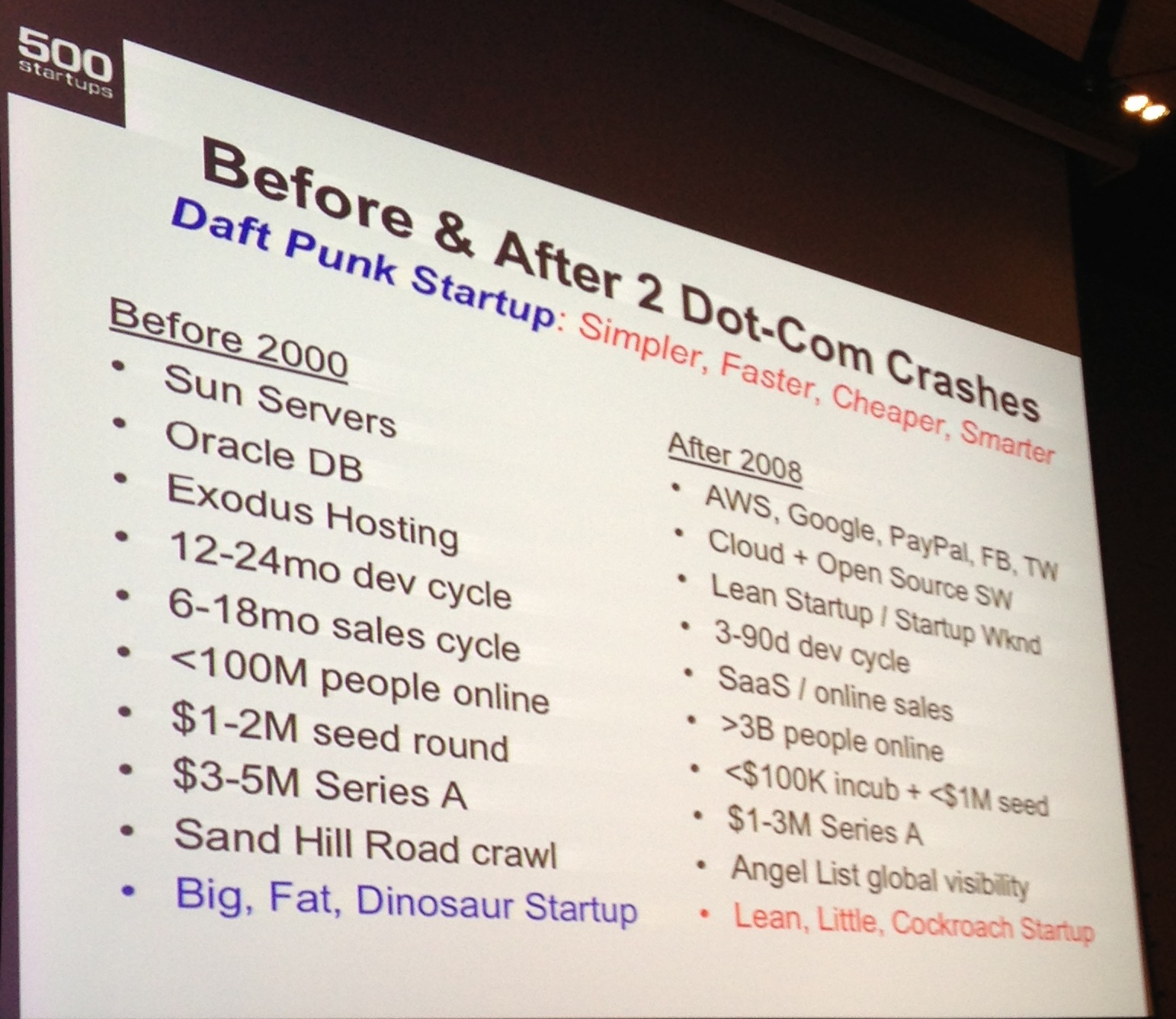
So at Echelon I snapped this slide from Dave McClure :

before_after

I am dating myself but I lived through the before 2000. Worked at a startup that had to spend most of our money just to turn on. We needed to buy Informix database, ATG app servers, Sun servers and racks in a hosting center – I think it was Consonus or something. Point being it is so much easier now. Grab your idea, some time to build it and give it a shot. Of course the competition is also stronger than ever and building a viable business model is not easy but at least it takes less hard capital than it used to.

It is a good time to be in startup land!

good luck.


“Hospitality” – our how I deal with customer service…

At the Fucking Cool Brunch there was a gentlemen there, the mixologist from the bar at 28 Hong Kong Street, who discussed the notion of hospitality. I found it fascinating since generally this is an overlooked topic in the tech industry. What I mean by this is how we treat our users or customers. I call them customers usually cause my goal is to extract revenue while serving them – rather than a user. Who uses. 😉

I stole this line from Wiki:

However, it still involves showing respect for one’s guests, providing for their needs, and treating them as equals.

There is so much in that line.

Respect – how many times have you been talked down to or berated by a customer support person? Remember that feeling next time you interact with one of your customers.

Provide – Customers have needs. The goal is to provide for them – sure you may not be able to and some of the needs may be silly but the idea is to try where it fits with your product goals.

Treat as equal – this kind of is like the first line – respect but the idea is to get off your tech high-horse and treat your customer as you would expect to be treated.

So given this I find customer support to be a really BIG deal. You work hard to get a customer – it is cheaper to keep them then to buy a new one. Fact.

I have some friends who have newsletter all about techies and customer support – check it out here :: https://twitter.com/TechSupport4Dev/

At Spuul, for now, I still handle most of the customer emails. It keeps me close to the product and the customer’s use of the product.

Generally all the support comes in via email, different channels, and I try to personally respond to all of them. Sometimes they are lengthy replies, sometimes they are check this FAQ and other times they are canned replies since the answer is quite simple. Typing out all of these replies can take too much time – sure shortcuts and textexpander would help but I have something better now – Dispatch. Made by one of the dudes who also makes the Spuul App .

  • I can make snippets and quickly reply to emails
  • I can take emails and save them off to evernote
  • I can use an email to quickly start an asana task
  • Animations are useful and the app is just pretty
  • I can go back and forth from the email and the preview while I type my reply.
  • It works and the whole idea of using my email client as a router to other things is growing on me

App is a 1.0 and obviously will evolve.

Email is not dead folks but only cause of some great innovation by independent  devs.

Customers service is any startup’s secret weapon – now you have a better tool to add to your arsenal.

Next post I will talk about Echelon, getting on TV and gruber.

laterz!

Singapore Rising…

I attended the Fucking Cool Brunch yesterday and was gently reminded of how far the scene has come in Singapore – events, quality of people, the interesting performance art, food, drinks and of course the tech. Being a techy I have to monitor this but as I have said before I think Singapore as an HQ for Global Companies keeps looking better and better. Yes – there are issues. Series A, employments visas, spaces to work and so on but I hope they will all be overcome as Singapore keeps evolving the model and marching on.

At the Brunch I met someone from MediaCorp and we had a nice healthy discussion around Singapore, the tech scene and the possible future landscape. Of course I can quickly digress and focus on the negatives but there is a reason I am in Singapore. I chose it. I value the residency capability, the rule of law, the infrastructure and the burgeoning scene. I feel that although there might be better better places to live or what some perceive as better markets – my gut says Singapore will come out on top of the SEA heap and become a place where one could setup, build and exit a global startup. I can’t prove this, yet, but it’s how I feel.

Apart from all of this the activity right now is high and the quality is good.

We have a conference/event scene that is always improving :: http://reddotrubyconf.com , http://e27.co/echelon/ , http://blinkbl-nk.com – I am sure there are examples of others but these are the ones I am into.

Then there is just all the periphery activity that is slowly evolving that is cementing the Startup Scene in Singapore:

Isaac penned a great Startup FAQ here :: http://sgentrepreneurs.com/2013/05/16/singapore-startup-faq/

Although I am not a huge Rocket fan you can’t ignore the activity they are bringing :: http://sgentrepreneurs.com/2013/05/22/zalora-reveals-massive-usd-100m-round-in-vote-of-confidence-for-fash-e-commerce-in-asia/

GOAP SEA :: http://500.co/2013/03/13/this-summers-biggest-blockbuster-geeks-on-a-plane-southeast-asia/

The new 500 Durians Fund :: http://www.zdnet.com/500-startups-launches-10m-500-durians-fund-for-southeast-asia-7000016104/

The success of JFDI :: http://insidethenoodlebowl.com/singapores-jfdi-asia-puts-southeast-asias-accelerators-on-the-map – looking forward to demo night tomorrow night. I will try to live tweet my reactions. 😉

In general the mainstream tech press, written by a local, is waking up to the size and opportunity in SEA :: http://thenextweb.com/asia/2013/01/03/2013-in-southeast-asia/

Yes – still waiting for new Series A entrants who will set up shop in Singapore but I think it will come.

Been in Singapore for over 3 years and in Asia for about 13 years. The current activity is unprecedented – and I don’t think it is a bubble. It is just the natural progression of the tech world waking up to how big SEA is. It isn’t easy to operate here but I think it is worth it. My personal goal is to show that one can build a big global business right here in Singapore. So lately I am focused on doing just that while doing my best to stay plugged in.

Going to be a busy week!

Response to the noodle bowl… (The four biggest issues for Southeast Asia’s startup ecosystem)

I won’t get into how jealous I am of Jon being on svbtle, very stoked for you Jon, but your latest post, http://insidethenoodlebowl.com/the-four-big-issues-for-southeast-asias-startup-ecosystem, got me thinking a bit. I agree with pretty much all of it so this is not really a rebuttal but to add some more color to point #3.

3. Lack of big firm presence: Founders invariably gain experience and ideas from working for big firms or other startups, that’s much harder when the few major players that are in the region – eg Google – hire sales and marketing staff rather than technical teams. Few from Silicon Valley would come back to Asia to start a company – though that could change in the future.

I may be asking to much on this thread in general but one of the things that I am not too impressed about with all the local big firms is their local technical support/escalation path for startups seeking assistance in Southeast Asia. I won’t name names when it comes to shaming since it won’t do me any good but I will state that Amazon or AWS is absolutely fantastic and tops in my book. In the world of startups – spuul is just a minnow but yet AWS is so responsive and extremely helpful. They check in on us regularly and bring many a good technical talent by our office to help us further our capabilities. Love the support and the technical talent in the region working for AWS continues to get more impressive.

We have had good luck with Apple as well when it comes to developer support but it could just be that we have a good line to them via one of our devs. I am not sure that everyone else gets the same support.

Google has also been helpful but it usually takes a lot of persistence and it is mostly cause I know a lot of folks there.

I think for the region to really take off the various big companies must offer a lot more product/technical support in the region hopefully from people who are in the region or at least a nearby time zone. Most of the companies continue to support from the valley and apart from conferences, dev events and evangelism – there is not a steady stream of information and local support.

I hope it changes for the benefit of the region.

If only Thailand had a clue…

I love Thailand. Have since the moment I first arrived for a business trip. The chaos, the city of Bangkok, the mountains, the oceans, the people, the food and this list can go on and on. However the place is not without it’s issues – just check this article for the silly reaction to a skit on SNL making fun of the sex biz in Thailand. I won’t get into how the biz is mostly run by and for Thais and is ingrained in Thai culture. Plenty of interesting books on the subject if you think I am off in left field here.

However I digress. Thailand has so many positive points but the country usually gains notoriety for its problems and usually these problems are self inflicted.

So that being said I am continually amazed why Thailand doesn’t quickly and decisively leap frog most of SEA by going for the Gold in the startup olympics. There is a startup fever in SEA – the HQ for this is Singapore but we all know the place is getting way too expensive. Many folks decamp for Malaysia or even work in Singapore and sneak across the border to live. Lots of folks setup shop in Indonesia which works for some but Jakarta traffic and lack of transportation infrastructure keeps folks like me out. Vietnam is cool and all but it is too much a mini China for me with the censorship and the government protection racket for incumbent companies.

So back to Thailand. It has issues. Freedom of speech, censorship and some others I won’t get into to. All in all though Thailand could be a great hub for SEA startups but the funding scene, the work permit and company issues tend to drive out anyone but the locals from really making a go of it. Sure I know there are startups in Thailand not started by the locals but there are plenty of stories from those who have tried and promise never to do it again. Some of those folks still work and live in Thailand but don’t form companies and legally stay via marriage or education visas. All good but not really the most convenient.

So when one see what Canada is doing to get startups to come to their country – I silently dream about Thailand doing the same thing. I know it won’t happen but it is possible and it would radically change the SEA landscape since Thailand is a good place to live, has talent and is starting to attract lots of hip people who just want to be here ( I know an investment banker thinking of jumping from Singapore to Thailand cause he thinks it might be a better city to live in for a while) but startups face such an uphill battle to be legal in Thailand if they are not founded by Thais. I won’t even get into the inane work permit requirements, the silly annual audits and all the other red tape that is death to a lean startup machine.

I will keep dreaming. Hoping that maybe someone in a big meeting room somewhere in some part of the Thai government decides to get radical.

6 trends Startups must cope with :: SEA Style

Saw this on the RWW:

http://readwrite.com/2012/12/26/6-trends-startups-must-cope-with-in-2013-from-paul-kedrosky

The main points with my commentary:

1. Accelerators Will Slow Down

This is interesting from an SEA angle cause for the most part the accelerator phase is just getting real in SEA. I can speak for each region or country since they all have their own twist on this but in Singapore I think http://jfdi.asia and http://pollenizer.com are just getting going. I think Singapore, if it keeps to being a regional hub, will have room for a few strong accelerators who will ultimately be successful. However I do think that the idea of each country having their own might get a little over done and won’t make it. I think their will be consolidation and a regional focus.

2. The Enterprise Will Strike Back

So far in SEA you just don’t see enterprise companies that much. It is typically an American or European thing or specific to say Japan or China but this could change. However I just don’t see the culture of Asia and the young entrepreneurs going after enterprise. It could happen though and as the enterprise looks sexy again it might accelerate.

3. The Cash Gap Will Fix the Talent Gap

We shall see in SEA if this is true. My feeling is this region is just getting serious about startups and their potential which means the talent crunch might continue. In Singapore it already feels like the bar is getting too high to bring expats in or non Singaporeans to take startup gigs. Within specific countries I think smart startup folks can find the right locals to make something go and may not feel the crunch anyway. I think Singapore is a unique problem since their is not enough locals to take startup gigs so startups are forced to import which is getting more expensive and time consuming.

4. Venture Capital Will Rebound

In SEA there really isn’t any series A anyway. So I don’t see a rebound but maybe there is a chance that the region will grow their series A ecosystem and we will see more series A funding. Right now most startups look to the valley, Japan, China and India for proper series A. This is a big hole in Singapore and the regional ecosystem.

5. Startup Ecosystems Will Go Extinct

It is quite possible that the region has overdone the singularity or country specific ecosystems. I have always argued for regional focus and will be interesting to watch. I think it is early days and some countries like Indonesia are big enough to contain their own ecosystem but maybe Thailand isn’t? Not way to tell but I think Singapore is doing okay but will need to figure out how to attract talent, make startup life affordable and keep growing. Maybe SEA is the ecosystem in this regard and it will do fine. Jury is out.

6. Big Data Will Crash

Big Data hasn’t really happened in SEA – meaning startups might be practicing it but not building businesses around it. I think both businesses built around social and big data are not going to make it in SEA anyway. We shall see how this goes but the fringe businesses selling the picks and shovels to people with real businesses don’t always do well unless the pick is a must have – like AWS, Akamai, Heroku and so on.

All in all I think some of these trends will have their place in SEA and some won’t.

For a different take on all this – check out Jon Russell’s latest on TNW.