Don’t really follow the guy and this is the first book I have read by him.
Let’s see how it goes
radical candour from a deep generalist
Don’t really follow the guy and this is the first book I have read by him.
Let’s see how it goes
I have written a few times on Product Management and of course this is something thst can be talked about till the cows come home. It’s a good topic.
I used to work with Cody and have followed his musing at Techstars as well.
I like his latest article and it has me thinking again :: https://medium.com/techstars/why-most-product-roadmaps-are-a-train-wreck-and-how-to-fix-this-12617e3adabc#.eht5nsqxc
And yet every single investor deck, board deck, and company all hands deck has it. And it’s a train-wreck. You know what I’m talking about. The 12-month product roadmap.
Painful but mostly true.
I do agree with the learning construct and that we all know the 12 month roadmap is not written in stone. Meaning in month 3 you may learn something so profound that you completely alter your roadmap.
For me I tend to think you want to pick a solid high level direction with some sense of what folks are working on and then realize that along the way it will change. The goal is to change based on the data and the learning from how things are going.
Cody sets out an interesting model for how to address that below:
Start Learning Now
As I visit our various Techstars programs across the world, the thing I try to impress upon the companies I meet with is to try to change your company habits into a learning-based culture by doing two things:
- Every person in the company should have a daily individual learning goal. Each person should wake up each day and have one thing that they plan to learn about their product, market, or customers that day that they can learn in 10 minutes or less without writing code. You can learn it by studying your analytics dashboard, by asking your customers something new that day, or by reviewing sales or purchase data. But make a point of learning something and sharing it back with your team or your company during standup.
- Have a weekly company-wide learning goal. This should be a goal that the entire company works in some way shape or form toward learning in a given week. It should be established at a weekly all hands or sprint planning session and reported back to the company with lessons learned (ideally in the form of data) the following week. It should be meaningful and may require some work. And if you really get in a habit of doing this well, you’ll soon increase your throughput and will have bandwidth to do more than one company-wide learning goal per week and will soon have a bigger backlog of desired learning goals than you can imagine (which, aha moment here!, becomes your Learning Roadmap!)
Remember, if you don’t have data, you only have hope. And none of us are doing what we’re doing because we hope it will work. We believe it will work and we’re doing everything we can to validate our beliefs every single day.
It reminds me of the Pollenizer guys and their flearn concept :: http://anthillonline.com/fail-learn-flearn-tweet-it-post-it-and-most-importantly-share-it/
Fail and learn and retool. One way to look at product management.
Great stuff!
Amazing to see how far Ben has come in a very short period of time.
Will get to Code Media next year.
Been reading Good To Great and this just really jumped out at me. Startups will also have some sort of a lost battle or big failure but what’s important is being able to carry out an autopsy without laying blame so that the entire company can benefit from the post mortem.

I won’t lie – I dig this dude. I don’t agree with all of it but most of it.
Some highlights to track:
All in all another good video from Scott.
Update – This link is interesting and painful :: http://www.politico.com/media/story/2017/01/medium-pivot-catches-publishing-partners-by-surprise-004907
Read this today :: http://daringfireball.net/linked/2017/01/04/williams-medium
Have this conversation going on facebook :: https://www.facebook.com/stuartmcdonald007/posts/10154007252602062
Here is the investor and fan weighing in :: https://500ish.com/long-medium-b9ddfe2c3a0a#.dnwmbtx85
There is a section in today’s Reliable Sources about the Medium stuff as well :: http://us11.campaign-archive1.com/?u=47c9040f6ff957a59bd88396e&id=ac7d0f9073&e=0e78a818f4
I am sure there is lots of other chatter about this topic today. Medium is kind of an internet darling and a big layoff like this is a big deal. I personally think Medium got a little to big for what they are trying to do and this seems to confirm that.
I have tried it a few times and it is slick. But I did not find that my audience went up any in using it versus using my own blog and my normal channels for promoting it. I am guessing over time if my articles where chosen or highlighted I would see a pop but guessing it wouldn’t happen much.
I have always felt I should have my own stack so to speak. Normally this has been self hosted wordpress blog but recently with my domain name change I decided to try wordpress hosting since it is cheaper, I get SSL and so far everything just works. Given it is wordpress I feel it is easy to move it around and keep everything intact. In fact moving everything to the new domain took an hour or so – even importing all the posts and comments. Only thing I couldn’t get to import right was stats but it is a new year so what the hell. I know my high watermark anyway.
My needs are different from others though who poetntially want to derive their income from writing. I have no such goals. I just want to write and interact. If I did need to make money from it I am not sure that running a blog would work regardless. Very few are able to live off it and most have to do lots of shitty ads or promotional things to make it work. I do link to Amazon stuff but I don’t expect it net me much – I figure it just makes it easier for readers to order a book or see what I am referring to. I do see what Medium is trying to do and I can see why some want Medium to create a platform that might generate revenue.
However I am not clear how Medium will do it or if it will work.
I like Ev. I respect him the most out of the twitter crew and wish he had stayed to make twitter happen but oh well. Let’s hope Medium figures it out but wondering if the whole notion of making this a big venture backed thing is working for them.
Time will tell.
Been reading the new book :: Good to Great: Why Some Companies Make the Leap and Others Don’t – super interesting.
One of the things I find fascinating is the discussion around the traits of those who have built great companies and pretty much in all cases Ego is not on the list or the wanting to be known as the person running the company versus letting the results speak.
So I am listening to this Gimlet startup podcast about the founder of American Apparel. This is part 4 but all of it been pretty good and best to listen to them all :: https://overcast.fm/+DHBqvB8A4 . So Dove has started three t-shirt companies at this point. First two went bankrupt whether he claims to be the one who caused it or not.
Now he is working on this third :: http://www.businessinsider.sg/american-apparel-founder-dov-charney-is-back-thats-los-angeles-2016-9/
The lines I am trying to draw is although this guy has been able to build a big business from scratch, they always fail – usually going bankrupt. When you listen to him speak on the podcast he has some amazing ideas and is also trying to local manufacturing. Dig it.
But when you listen closely to him during some of the conversations he will discuss how even when American Apparel was cranking he was upset that people did not know that he was behind it.
Boom. Ego. His desire to have a name seems to always interfere and lead to his downfall.
Silly.
Wonder what happens this time. 3rd time a charm?
The Thiel stuff just rubs me the wrong way. I won’t lie.
http://www.nokpis.com/2016/10/18/y-combinator-and-peter-thiel/
I will leave the thread at that with my last addition from Dan Primack.
I will then remind folks of this post, since the world just need more “E” :: http://www.nokpis.com/2016/10/17/empathy/
A friend shared this link about Sesame Street and Empathy. It’s awesome :: http://www.npr.org/sections/ed/2016/10/17/497827991/a-sesame-study-in-kindness
Makes me freak out a bit about raising kids. It is not about just having polite kids but having kids who generally care and who want to help others. I see as my kids grow they easily can remain polite but yet not helpful or caring.
Empathy. Spread it around. It’s good for everyone.
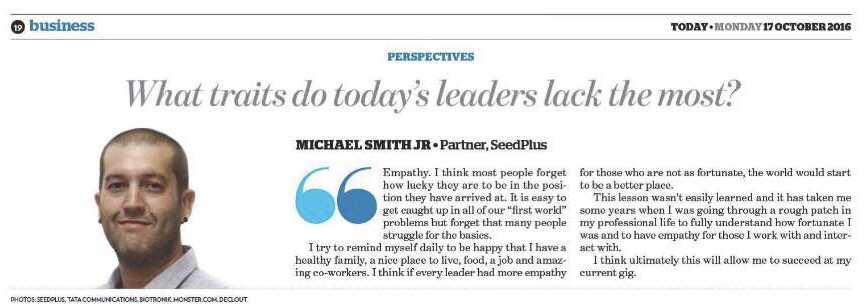
When I had the chance to answer this question for the Today newspaper –
What traits do today’s leaders lack most?
I wasn’t sure what I was going to say. I was thinking of techy stuff. Then was thinking about the future.
But then I started thinking about people.
This post hints at why :: https://bothsidesofthetable.com/venture-capital-is-about-human-capital-4d51da6b2b87#.limhpd6rw
So I tell people we’re fundamentally in the people business. Our core skill is being able to identify talent and how to persuade the most talented people with whom we have access that we would be valuable to work with. We then help surround founders with other talent who want to join important causes but don’t have the startup idea themselves. We help founders through difficult moments, we help coach, we act as sparring partners, we help them resolve conflicts when they’re fighting with co-founders and we help them deal with adversity as well as successes.
I am learning. I am a VC in training, but I know everything is about people.
I think we are all so spoiled sometimes that we forget how lucky we are.
That is what my answer to this question was and is, empathy.
I suggest more of us should put empathy first. It makes everything better.
🙂
 Had a great time at the Deal Street Asia Event :: http://www.dealstreetasia.com/events/
I think my panel went pretty well and hopefully I can join the crew in some way again next year.
To my left, your right, is Jeffrey Perlman who is the MD for SEA Region of Warburg Pincus.
In talking to Jeffrey I was reminded of my BEA years and working with Bill Janeway. I told Jeffrey about my BEA experience and he immediately commented that this is still one of the single best returns that Warburg ever had:
In 1992, the firm funded the launch of OpenVision Technologies, which subsequently merged with VERITAS Software in 1996. In 1999, Warburg Pincus also was the founder and sole investor in BEA Systems. Warburg Pincus eventually distributed its positions in both companies to its limited partners, realizing total returns of $750 million in VERITAS shares and $6.5 billion in BEA shares on investments in each of approximately $50 million.
6.5 billion on 50 million. Insane.
Has to be one of the best deals not only for Warburg but for the industry.
 Dreampipe's Blog