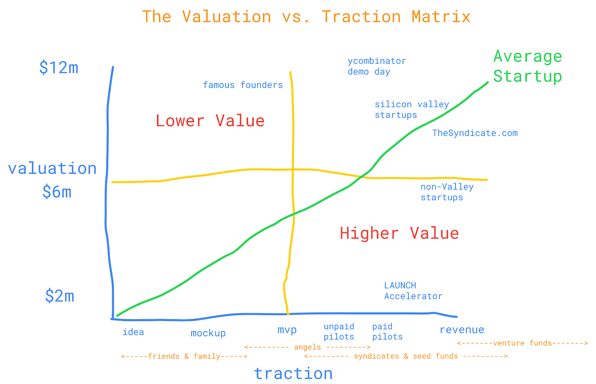
The Valuation vs. Traction Matrix – Jason Calacanis

Pasted image 0

Image from here :: The Valuation vs. Traction Matrix – Jason Calacanis

Great post. Will try to dive into it more later.

This is good though:

Startup valuations are not science, but they’re not magic either. It’s a bit of alchemy, combined with bizarre marketplace dynamics like famous founders getting 3x the price for half the traction, or Y Combinator hosting a gigantic demo day in order to create FOMO with novice investors who are explicitly told not to think things through and just cut a big check (literally, that’s their bad advice to investors).

Transactional Angst

I think nary a week goes by where someone doesn’t ask me how VC is going and when am I going back. I guess back means to return to building something, joining a company or working on a product.

It’s normally something that requires a longer answer but usually I say ask me in 10 years. That’s cause it will probably take me that long to see if I am any good at this VC thing. 

That being said I think people ask this due to the very nature of VC being somewhat transactional and maybe building something is more of a co-op approach since there are teams involved all working together to ship. It is a sentiment I think about a lot.

Saw this tweet the other day and was thinking about it even more:

https://twitter.com/joshelman/status/1109497183445803008

However I always consider that there may be a better way but I am not saying I discovered it but highlighting that each and every craftsman in the world can approach their craft with a new frame of mind. With VC I think about what that means often. 

Let me run down a few areas I think as a VC I can be more like the product person still living inside me:

  • Be open and transparent. Of course not everyone reacts well to this but I find a certain amount of it works
  • Be humble 
  • Be helpful
  • Have empathy for the founder and the other people/organizations in the mix
  • Try to write often enough so people can see what’s on my mind and how I feel about something
  • Continue to focus on doing the right thing – it may not payoff immediately but I believe it will win in the end
  • Learn to listen more – speak less. I am terrible at this but I am very conscious of improving it. That’s a start right? 😉
  • Foster an ecosystem since everyone will benefit (https://alpha.seedplus.com)
  • Be company friendly. This is a long one to explain but I think the right folks now what I mean

I don’t intend to go back as some people call it since I think I moved forward while still getting better at my craft. I see my craft as helping build great companies by being their investor and whatever else they need me to be while I am in that role. 

Pretty sure that is similar to what I did as a product person but I am not an employee or a founder.

However the North Star feels similar to me.

Your mileage may vary.

Elizabeth Warren Wants To Break Up Amazon, Google And Facebook; But Does Her Plan Make Any Sense? | Techdirt

The whole thing is a good read. I don’t have the answers but I think competing with these big companies gets harder and harder with each passing year. That’s a problem – maybe breaking them up would help but I think the process to do so is too convoluted and costly.

I think fighting anti-competitive behaviour has to be the first line of attack and even on the record America isn’t doing well at all.

Elizabeth Warren Wants To Break Up Amazon, Google And Facebook; But Does Her Plan Make Any Sense? | Techdirt:

And, again, none of this is to say we shouldn’t be concerned about big internet companies with too much power. It’s a perfectly reasonable concern, but just because you want to “do something” and “this is something,” doesn’t mean that it’s the something we should do. The way to attack the positions of these big internet companies is to enable more competition — and you do that by encouraging alternatives in the marketplace. This is why I’m actually hopeful that some of these companies will actually start to explore an idea of moving to protocols, rather than owning the whole platform themselves, or that we’ll see new protocols springing up.

Meanwhile, if Warren were truly concerned about “monopolies” and a lack of competition, why isn’t her plan looking at the lack of competition in the broadband and mobile markets — cases where we have legitimate competition problems due to bad regulatory policies going back decades?

The Seed Slump – AVC

This is a good post pointing to a few of the other threads and posts talking about the Seed Slump.

The Seed Slump – AVC

I think this tweet is good as well:

These are the takeaways:

  • seed to A graduation % obviously will go down
  • seed funds which stay small & generate smallcap exits can make

Bootstrap or not.

Lots of chatter about this recently. 

Maybe it all kicked off with this article :: https://www.nytimes.com/2019/01/11/technology/start-ups-rejecting-venture-capital.html

I co-taught a class the other day at Insead and the subject was around boot strapping versus raising money. It really is an easy answer to be honest. If you can bootstrap then my advice, as a VC, is you should. Why take money if you don’t need to?

However people need to properly call out stuff – meaning bootstrapping typically means funding the company from operations or revenue. If you borrow money, have an angel investor or pumped in a bunch of your own money – you still took or made an investment. You now have investors and frankly this bit that VC money is bad but other money is good is silly. All money comes with terms and all of it expects to be paid back.

The only caveat to this is your own money could potentially be treated differently since you are the founder and you own the company. You could potentially never pay yourself back and settle yourself with an exit or profits.

I see so many silly deals in startup land where the founder stayed away from professional investors, say a VC, but took silly angel money and signed bad terms. I am quite sure those companies are worse off than another startup who took a round from a VC. Keep in mind angels can be evil, your rich uncle can be evil – obviously so can a VC. The point is know the terms of your money and its impact on you and your company.

The core difference in bootstrapping and not is really about growth. This does not mean that VC money encourages or forces growth – the VC can’t really force anything. It is your company but if you take VC money than you are expected to grow more or faster than if you didn’t. That is not some sinister plot by VC’s BTW – it is simply the notion that the capital is easier to get and more expensive therefore you need to use it accordingly. If you don’t like that grand bargain, then don’t take the money.

It is not like VC’s sit around and are desperate to throw money at someone in hopes of forcing them to do something they didn’t plan on doing. This is silly. Everyone knows what the deal is and believe me, we never write a check to any founder that isn’t on that same page.

That would be a waste of capital.

If you can build a solid business without VC money then do it. However don’t raise money from less than professional sources or with crappy terms and pretend this is better. Truly bootstrapping is generally from revenue. Most folks have a hard time doing that. If you can then great, you own more of the company and the outcome is generally better. That is the other myth to dispel – if you raise lots of money and don’t have a huge exit then you will take home less than someone who didn’t raise any money with a smaller exit. It’s just math.

If you have a method for using capital to grow much bigger and faster than if you didn’t take capital, plus you are comfortable with the terms and your investors then take the money. The decision rests with the founders, and VC’s only work with founders who already have arrived at making this decision for themselves.